Ghosting — the act of disappearing during dating — has become increasingly common (except for our clients, as we are handling the rejection part for them).
Research from California State University (source) among students shows that while most people value honesty and directness when ending a relationship, ghosting is still seen as “acceptable” in certain situations — especially after brief or casual interactions, or when someone feels unsafe or lacks the interpersonal skills to confront their partner directly.
Interestingly, men were more likely to view ghosting as acceptable than women, who generally prefer clear and respectful communication. Personality and values also shaped perceptions: those who highly value honesty were less likely to approve of ghosting, while students who prioritize kindness were somewhat more forgiving of indirect breakup approaches, like reducing contact or giving vague explanations.
Still, even with good intentions, disappearing without explanation often leaves the other person feeling confused or unappreciated.
On the other side, we’ve heard of situations where a client’s honest message triggered a very negative reaction — proving that being too honest isn’t always the kindest choice. Our advice is that you don’t owe a full explanation, and rejection doesn’t need to be brutally honest. Sometimes, a gentle “white lie” can soften the message while keeping it respectful. In these moments, respect comes first, honesty second.
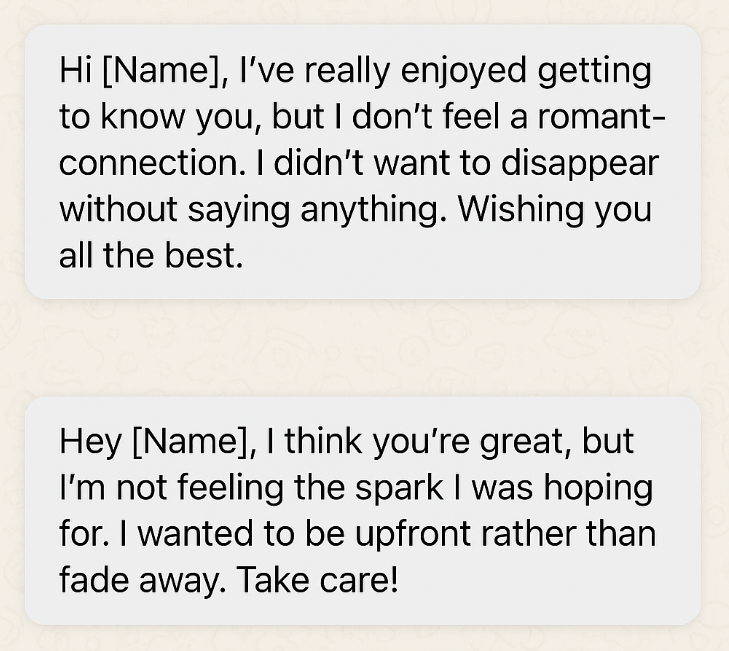
Here are a couple of anti-ghosting message examples that balance honesty and respect — so you never have to ghost anyone again:
“Hi [Name], I’ve really enjoyed getting to know you, but I don’t feel a romantic connection. I didn’t want to disappear without saying anything. Wishing you all the best.”
“Hey [Name], I think you’re great, but I’m not feeling the spark I was hoping for. I wanted to be upfront rather than fade away. Take care!”
Research from California State University (source) among students shows that while most people value honesty and directness when ending a relationship, ghosting is still seen as “acceptable” in certain situations — especially after brief or casual interactions, or when someone feels unsafe or lacks the interpersonal skills to confront their partner directly.
Interestingly, men were more likely to view ghosting as acceptable than women, who generally prefer clear and respectful communication. Personality and values also shaped perceptions: those who highly value honesty were less likely to approve of ghosting, while students who prioritize kindness were somewhat more forgiving of indirect breakup approaches, like reducing contact or giving vague explanations.
Still, even with good intentions, disappearing without explanation often leaves the other person feeling confused or unappreciated.
On the other side, we’ve heard of situations where a client’s honest message triggered a very negative reaction — proving that being too honest isn’t always the kindest choice. Our advice is that you don’t owe a full explanation, and rejection doesn’t need to be brutally honest. Sometimes, a gentle “white lie” can soften the message while keeping it respectful. In these moments, respect comes first, honesty second.
Here are a couple of anti-ghosting message examples that balance honesty and respect — so you never have to ghost anyone again:
“Hi [Name], I’ve really enjoyed getting to know you, but I don’t feel a romantic connection. I didn’t want to disappear without saying anything. Wishing you all the best.”
“Hey [Name], I think you’re great, but I’m not feeling the spark I was hoping for. I wanted to be upfront rather than fade away. Take care!”